When God Wrecks Your Plans

Many are the plans in the mind of a man,
    but it is the purpose of the Lord that will stand.

Proverbs 19:21

“How many of you know what it’s like to have God wreck your plans?”

I asked this question while preaching a couple of weeks ago. Several hands were raised, and even more smiled and nodded. This is one of those nearly universal Christian experiences. Our lives rarely go exactly the way we thought they would, and we find ourselves wrestling with God for answers–answers that He doesn’t always seem eager to give.

Let’s be honest: sometimes God wrecks our plans because we never included Him in the first place. Our plans were motivated by selfish ambition, foolish desires, or some other toxic source. Sometimes our faithful Father lovingly disrupts our lives in order to expose our idols and offer us an opportunity to repent. Hopefully we get the message and start over with godly priorities.

But this is not always the case. God reserves the right to do as He pleases, even with our best intentions. I can think of no better example than Paul’s itinerary, found in Romans 15.

I hope to see you in passing as I go to Spain, and to be helped on my journey there by you, once I have enjoyed your company for a while. At present, however, I am going to Jerusalem bringing aid to the saints.

Romans 15:24-25

Paul had been preaching for around 25 years by the time he wrote Romans. He had planted churches in several of the urban centers on the eastern side of the Roman Empire. Paul now had his sights on Spain, the western edge of the Roman Empire.

His plan was to stop by Jerusalem to bring financial aid to the believers there (money he had collected from other churches). From there he would pass through Rome and spend some time with the church there before heading to Spain.

That was Paul’s plan. It was prayerfully created and energized by Paul’s ambition to preach Christ where His name had never been heard (Romans 15:20-21).

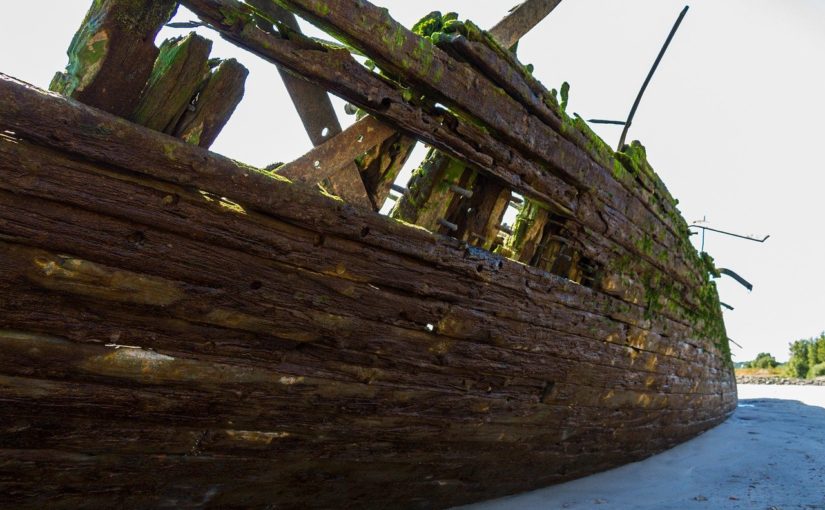
But God shipwrecked Paul’s plan–literally. He encountered hostile opposition in Jerusalem and was placed in Roman custody for his own protection. He appealed his case to Caesar before the Roman authorities. They granted his request and arranged for a sailboat to take him to Rome. The boat encountered a storm strong enough to crash it upon a reef. Paul and his fellow prisoners swam for their lives or rode planks to the shores of Malta.

Paul eventually made it to Rome, but his stay was not brief. He spent two years under house arrest, preaching and teaching those who came to visit him.

The events I’ve just described (recorded in Acts 21-28) were clearly not what Paul had in mind.

We don’t know, in fact, if Paul ever made it to Spain as he had planned. Here’s what we do know: Paul wrote the “prison letters” during this time of house arrest in Rome. These letters are recorded in our New Testament: Ephesians, Philippians, Colossians, and Philemon. These scriptures have blessed and instructed millions of believers–far beyond the geographical borders of Spain and long after the Roman Empire had fallen. God, as always, knew exactly what He was doing with His trusted servant.

This quote comes to mind:

God places His saints where they will bring the most glory to Him, and we are totally incapable of judging where that may be.

-Oswald Chambers

Lord, teach us to trust in Your greater purpose–even when this requires You to change, disrupt, or even destroy our plans.

NOTE: I have included this devotional in my book: Knowing God’s Will: Discovering His Plan for Your Life.

Philippines: Knowing God’s Will is Available!

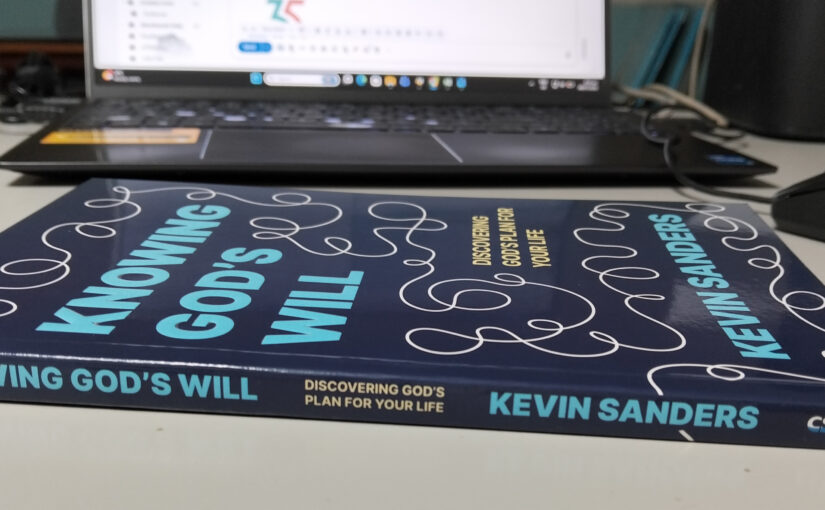
To all my friends in the Philippines: Knowing God’s Will is now available there locally! Same book, different cover.

I’m deeply thankful to CSM Publishing! You can order it directly from their website or wherever CSM publications are sold.

The whole idea for Knowing God’s Will was born in the Philippines. Here’s a quote from the introduction:

I preached and wrote on the topic of discerning God’s will about twenty years ago when I was a missionary in the Philippines. The series and blog posts were well-received at the time, and I hope I helped my young audience in their pursuit of God’s will. I’ve now had more time to think about this topic and to learn more life lessons.

The book also includes quite a few stories from my time as a missionary. It’s only fitting that it gets published in country that has meant so much to me! I pray that many Filipinos will be blessed and be part of the glorious adventure of following Christ.

One more note to my friends in the Philippines: I would greatly appreciate you sharing this post on your social media pages. I’m also more than happy to do radio/podcast interviews as my time permits.


When Life Crashes In

Kaleb Whitby was driving his Chevy Silverado on Interstate 84 in Oregon. One semi-truck jackknifed in front of him due to black ice and he was unable to keep from colliding into its side. Another tractor trailer came barreling straight towards them, also unable to stop. Whitby held onto the steering wheel, closed his eyes, and prayed for safety.

A few moments later he found himself encased in a mangled mass of metal that was once his truck. Sergi Karplyuk, one of the semi drivers, jumped out of his truck to check on Whitby’s well-being. Only Whitby’s head was visible, but he was completely coherent and able to communicate. Whitby, in fact, gave Karplyuk permission to take this shocking photograph which appeared on multiple news outlets:

Kaleb Whitby was freed from his truck and walked away with just a few scratches. The wreck was part of a 26-car pileup.

This story reminds me of a word I’ve encountered frequently in the New Testament: thlipsis (in the original Greek). I most recently ran across it in 2 Corinthians 6:4. Paul wrote of the multiple hardships he gladly endured for the sake of the gospel (2 Corinthians 6:4-5).

Thlipsis is often translated as “affliction,” “tribulation,” or “trouble.” The word is used to describe anything that causes us to suffer (physically, spiritually, or emotionally). But the word also meant to be pressured or constricted.

Any afflictions I have experienced would be considered “afflictions-lite” by Paul’s standards. But suffering has a way of making us lose our perspective—we can feel like we are having the life squeezed out of us.

God never promises a life without suffering, but He does promise something better: divine purpose in suffering. Consider this promise in Romans:

Not only that, but we rejoice in our sufferings, knowing that suffering produces endurance, and endurance produces character, and character produces hope, and hope does not put us to shame, because God’s love has been poured into our hearts through the Holy Spirit who has been given to us.

-Romans 5:3-5

There’s that word again, thlipsis, appearing twice and translated as “sufferings/suffering.” God promises that suffering/affliction is His holy process of producing qualities that can be formed no other way (endurance, character, and hope). I must remind myself of this when life isn’t going the way I think it should. I pray you will, too.