What is the World Coming to?

The last week or two has been filled with tragic news. If you’re like me, you may be wondering what this world is coming to. I can’t blame you.

I have decided not to say much on social media, but I do grieve deeply and pray for the families who have lost loved ones in the senseless violence.

But I’ve also found comfort in a place that may surprise you, a parable of Jesus known as the Parable of the Weeds (also known as the Parable of the Wheat and the Tares):

24 Here is another story Jesus told: “The Kingdom of Heaven is like a farmer who planted good seed in his field. 25 But that night as the workers slept, his enemy came and planted weeds among the wheat, then slipped away. 26 When the crop began to grow and produce grain, the weeds also grew.

27 “The farmer’s workers went to him and said, ‘Sir, the field where you planted that good seed is full of weeds! Where did they come from?’

28 “‘An enemy has done this!’ the farmer exclaimed.

“‘Should we pull out the weeds?’ they asked.

29 “‘No,’ he replied, ‘you’ll uproot the wheat if you do. 30 Let both grow together until the harvest. Then I will tell the harvesters to sort out the weeds, tie them into bundles, and burn them, and to put the wheat in the barn.’”

-Matthew 13:24-30 NLT

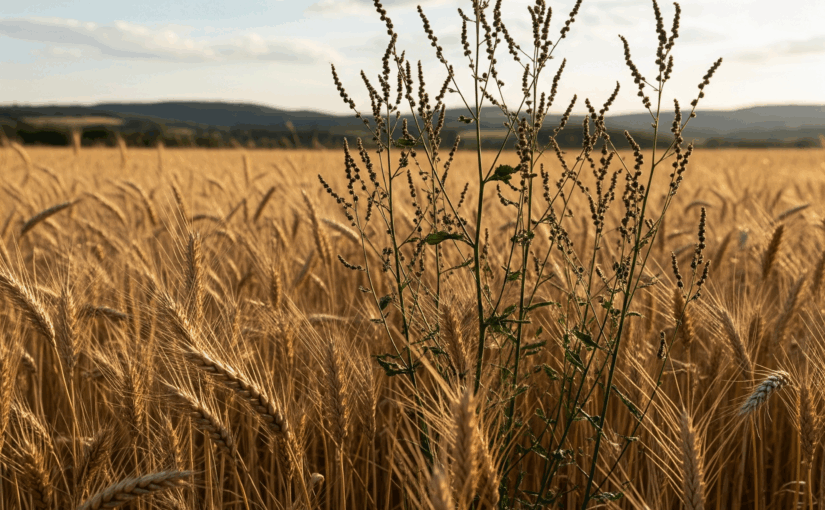
The scene Jesus presented in this parable would have been familiar to His ancient audience. A farmer planted wheat (good seed), but his enemy sowed weeds. This unwanted plant refers to the darnel weed. This weed is poisonous, but looks so much like wheat in the early stages that you can’t tell the difference between the two.

The planting of this kind of weed in someone’s field was a way to destroy or greatly reduce the value of your enemy’s crop. It happened frequently enough that there was a law against it in the Roman empire.

But the wise farmer knew that intervening prematurely would result in the loss of perfectly good wheat. He said in effect,“I’m still interested in all that wheat that’s planted out there.”

Herein lies the lessons that encourage me greatly:

The presence of evil in this world does not negate what God is doing in this world. The presence of evil does not nullify God’s redemptive activity. 

Yes, wicked people are becoming bolder, more perverse, and more hostile to all that is good. In that sense it seems the world is getting worse.

But here’s a question we must consider: are the “weeds” the only thing growing? No!

God has not given up on the harvest—neither should we!

God has sovereignly allowed evil for a season. He has temporarily allowed good and evil to coexist. One day there will be an awesome judgement in which God will separate wheat from weeds; good from evil (vs. 37-43). Until then, let’s not forget the words of Jesus:

“The harvest is great, but the workers are few. So pray to the Lord who is in charge of the harvest; ask him to send more workers into his fields.”

-Luke 10:2b

Let us not be guilty of only seeing the weeds and overlooking the wheat.

Grace for your Worst Moment

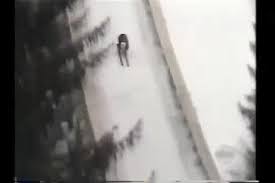
I remember watching a show called ABC’s Wide World of Sports when I was growing up. The introduction to the show included this line: “the thrill of victory, the agony of defeat.” A ski jumper would crash as a demonstration of the later statement.

I have since learned the skier’s name is Vinko Bogataj. He is a Yugoslavian painter who participated in a world ski championship in 1970. He was 22 at the time of the incident. He lost his balance as he approached the launching point, falling off the side and into a retaining fence. The accident sent him to the hospital with a mild concussion and a broken ankle.

A producer for ABC interviewed Bogataj in 1980 for a special anniversary edition of the show. “When we told him he’s been on the program ever since 1970,” said the producer, “he couldn’t believe it. He had been appearing on Television 130 times a year.”

Bogataj has apparently gone on to live a good life. He married, raised two daughters, and became an award-winning painter. He even enjoyed a certain celebrity status from the accident (he came to America a few times for guest appearances). He is now in his 70’s. Regardless, he is most famous for what was probably the worst few seconds of his life.

Reading Bogataj’s story makes me thankful that my worst moments were not captured on video (good thing I grew up in a world without ubiquitous cell phone cameras).

I suppose Vinko Bogataj’s accident is already fading from our collective consciousness (Wide World of Sports was discontinued in 1997). One of Jesus’ followers, however, had his worst moment recorded in the Gospels for all the world to read:

Now Peter was sitting outside in the courtyard. And a servant girl came up to him and said, “You also were with Jesus the Galilean.” But he denied it before them all, saying, “I do not know what you mean.” And when he went out to the entrance, another servant girl saw him, and she said to the bystanders, “This man was with Jesus of Nazareth.” And again he denied it with an oath: “I do not know the man.” After a little while the bystanders came up and said to Peter, “Certainly you too are one of them, for your accent betrays you.” Then he began to invoke a curse on himself and to swear, “I do not know the man.” And immediately the rooster crowed. And Peter remembered the saying of Jesus, “Before the rooster crows, you will deny me three times.” And he went out and wept bitterly.

Matthew 26:69-75

Peter and the other disciples had been warned. Jesus, in fact, told him that the enemy would shake all of the disciples to their core (Luke 22:31-34) and that they would scatter (Matthew 26:31).

But Peter stubbornly insisted that he would stand strong, even if the others did not. He considered his own self-assessment to be more accurate than the words of the Lord. I’ve repeated this warning to my congregation:

It’s a dangerous thing to overestimate your strength.
It’s a dangerous thing to underestimate your weakness; your ability to fall into sin.

Peter was capable of doing something worse than he ever imagined. He claimed he didn’t know Jesus, and each denial became more emphatic (he essentially called God as his witness while lying). This man who had walked with Jesus for three years did not have the strength to answer a slave girl and some random bystanders.

The sound of the rooster made Peter aware of his failure: he had denied the Lord three times!

This is one of the many times I’m grateful for the truthfulness of the Scriptures. The lives of the people God uses are more complicated than highlight reels of victories. They failed God, just like we do.

I’m even more grateful when I read the Gospel accounts of Peter’s restoration. Peter would preach boldly at Pentecost and became a pillar the church. According to Christian tradition, Peter was martyred by crucifixion. He insisted on being hung upside-down, saying he was unworthy to die in the same manner as the Lord.

God’s grace is greater than your worst failure.

This devotional is included in my new book entitled Knowing God’s Will: Discovering His Plan for Your Life.